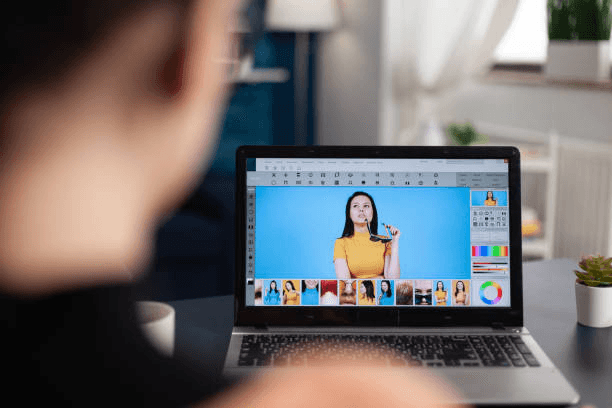
Introduction
I have recalled that seven years ago when one of the clients requested that I could create social media graphics to do a campaign and I did not have a budget to buy Adobe Creative Suite and the mild panic that I had then. That was what led me to the investigation of the free graphic design tools online: what actually works and to be honest, what I learned has transformed my approach to the way I am going to be doing my graphic design work.
The world of free design has changed significantly since that. What would be considered as a primitive watermark-infested sites are now truly as good as alternatives that I rely on even though now I can afford commercially offered software. Allow me to tell you what really works because of several years of practical experience.
Canva: The Obvious Choice That Genuinely Delivers
Canva has been suggested by everyone, and there is a purpose why it takes up the greater part of such discussions the free-of-charge version is extremely powerful. I have created everything, including Instagram posts and presentation slides, on the free level of Canva.
It is valuable when it has a template library. Instead of having to work off blank canvases (which is somewhat intimidating when you are not a designer yourself), you go through thousands of professionally designed templates and modify them to fit your needs. I made the full social media content calendar of one of my small bakery clients with free templates, colour changes, replacing images, and turning around the text. The findings were professional to the extent that individuals thought she had contracted a design company.
Photopea: The Photoshop Clone Nobody Talks About Enough
I have known Photopea, perhaps, three years ago, and I was truly shocked by the fact how powerful this browser-based editor can be. It intentionally resembles Adobe Photoshop, therefore, it has a learning curve in the event that you are not well-versed with professional design software. However, with some Photoshop background, you will feel right at home.
Personally, I have been using Photopea because of editing and composing photos and to a certain extent some light digital illustration work. The tool can work with PSD files, that is, you can open real Photoshop files and work with them, and save them in the same format in a browser. This interoperability helped me in several instances when I needed to work with the designers operating on the Adobe software.
It is refreshing since there is no account required and the access is absolutely free. And, just go to the site and get working. The interface contains advertisements, these are the ways the developer earns money on the free version, but they are not so offensive to make work significantly disrupted.
Figma: Professional-Grade for Digital Design
Figma is the new standard of the industry regarding designing user interfaces and user experiences, and strikingly, the Figma free version is available to individuals and even teams. I mostly adopt Figma to do mockups of websites, the interface of an application, and anything that involves various designers.
The web-based application (that has optional desktop apps) implies that you can work anywhere. I have actually constructed website layouts on my laptop in a coffee shop, and then proceeded to the same project on my desk at home with no file transfers or file sync problems.
It has great capabilities of editing vectors. Figma is a vector-based editor, unlike pixel-based editors where the graphics are infinite, and expansion does not deteriorate quality. This suits well in the creation of logos or anything that should work in a variety of sizes.
GIMP: The Open-Source Powerhouse
Gimp (GNU Image Manipulation Program) is technically not an online tool but a desktop one, but it has to be mentioned as the most potent entirely free design tool that could be found. I have been working with Gimp over and under the years, especially when it comes to more or less strenuous actions involving the manipulation of photos which need a much advanced photo editing tool that Photopea just cannot manage without any problems.
The features compete with Photoshop in most aspects representing the presence of layers, masks, filters, colour fixing, and the presence of plugins. I have worked on all the subjects of portrait retouching to creating intricate art in Gimp.
The interface is… not attractive. It is usable, a bit clumsy, and certainly open-source in a manner that can be irritating to those who want Adobe-like refinement. However, to get free software that has this amount of power, complaining about looks is unappreciative.
Removing Backgrounds: Remove.bg
This one-purpose application performs one thing extraordinarily well, namely, it offers an automatic way of removing backgrounds of photographs. I pursue it everywhere with the product photographs, portraits or any other image, where I require the subject on the
transparent background.
The free version works with images of standard resolution well. This is because higher resolution export comes at a cost in terms of credits or payment, however, in the case of social media graphic or web, the free option is more than adequate. I have used only the free tier in browsing dozens of image products of an online store.
Conclusion
The way I use all these tools together is as follows: Canva to create an adorable graphic or template as quick as possible, Figma to design web and interface, Photopea to edit files to the extent of Photoshop in my browser, and Remove.bg to save a background and remove it.
With an average small business customer that requires the usage of social media, email graphics, and the simplest branding, I can seldom get by without Canva and sometimes even Photopea. The free tools of 2025 are indeed adequate to probably 80 percent of the small business graphic design requirement.
The other 20 percent-advanced print designing, professional photography editing, complicated work of illustration- also- enjoys the benefits of professional paid software. However, when it comes to Instagram posts and Facebook banners, you are only pretending like you need Adobe Creative Suite to do it, and that is merely obsolete way of thinking.
FAQs
Is it possible to use free design tools to do business work?
Yes, the majority of free tools, such as Canva, Figma, and Photopea, display a permission to commercial use. Always verify that there is the specific licensing of templates or stock elements that you use.
What is the most suitable free tool, being a total beginner?
The ease of the template-driven design and the user-friendly interface of Canva could make it the perfect tool that allows individuals with zero experience in design to achieve fast yet professional outcomes.
Is it possible to substitute such paid programs, as Photoshop, with free ones?
For many users, yes. Photopea is quite similar in its functionality with Photoshop. Nevertheless, Adobe still might be the choice of professional photographers and designers due to the sophisticated features and ecosystem offered.
Are these free tools mobile compatible?
Canva boasts of great mobile applications. Photopea and Figma are mobile browsers that are adapted to desktop use. GIMP is desktop-only.
Are free tools limited on file format?
The majority of the supported popular types (JPG, PNG, PDF). Photopea works with the files of PSD directly. Figma has many formats of export. It is always good to ensure that your desired outcome is supported.
Also Read: Best Laptops for Remote Work 2026: Your Complete Buying Guide